Snowshoe hiking is not just an activity for people living in cold northern regions. Germany also has many mountain areas where visitors can explore snowy landscapes on snowshoes.
Whether you are a beginner or an experienced hiker, there are several snowshoe hiking routes in Germany worth exploring. You can join a guided tour with an instructor or follow suitable winter trails on your own.
Many destinations also offer snowshoe rentals, making it easier to try the activity without buying your own equipment.
Before starting, remember to respect other winter sports users. Avoid walking on prepared ski tracks because snowshoes can damage them. Instead, follow suitable snowshoe routes or create your own tracks in fresh snow where permitted.
Snowshoe Hiking in Germany: 7 Beautiful Routes
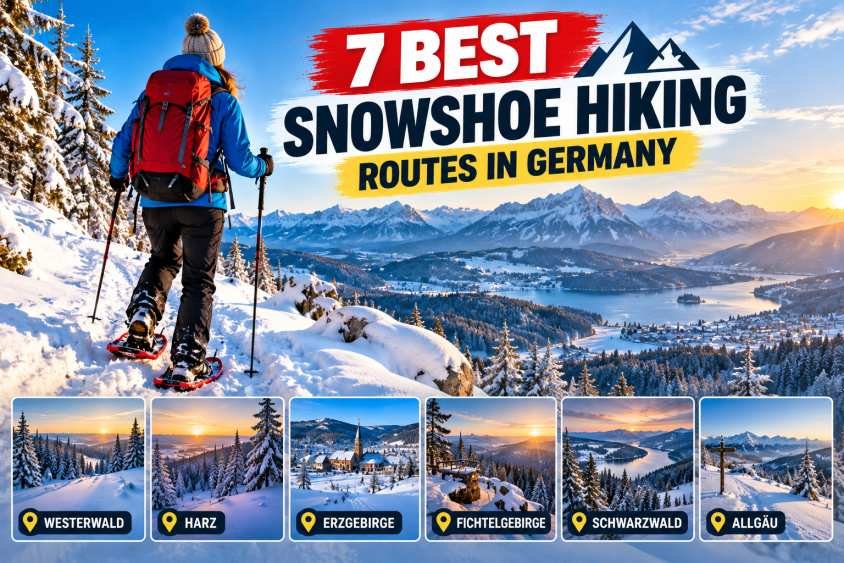
Here are seven destinations where you can experience winter hiking in Germany on snowshoes. The routes range from easy walks to longer mountain tours.
1. Westerwald: Fuchskaute
Elevation: Up to 657 meters
Fuchskaute is the highest point in the Westerwald region. It is a good destination for people who want to try snowshoe hiking in Germany in a peaceful natural setting.
Hiking guide Christoph Diefenbach offers guided snowshoe tours, including equipment. The route leads towards the 657-meter summit, which is relatively easy to reach because the surrounding landscape is not particularly steep.
Along the way, you will pass fir and spruce trees covered in snow. The quiet forest and fresh snow make this area suitable for a relaxing winter walk.
Fuchskaute is also known for its large arnica meadows, which attract visitors during the warmer months.
Best for: Guided snowshoe hikes, beginners, and peaceful winter walks.
2. Harz: Hahnenklee-Bockswiese
Elevation: Up to 726 meters
Hahnenklee-Bockswiese is a suitable destination for snowshoe hiking for beginners. The area has shorter hiking routes and circular trails that are easier to manage.
You can rent snowshoes, often called Bigfoots, from the Seasons ski rental shop in Goslar-Hahnenklee. The competitor lists rental prices of around €5–€10 per day.
For route information, visit the Hahnenklee tourist information office and ask for a map of the snowshoe trails. One suggested route is a family-friendly circular trail of around two kilometers.
Basic Snowshoe Walking Technique
Good walking technique makes snowshoe hiking easier. Place your heel down first and roll your foot forward through the middle of the shoe. Keep your steps even and your feet parallel.
Try to keep your body weight above the middle of the snowshoe to reduce sinking into the snow. Walking poles with wide winter baskets can also help you maintain balance and move forward.
Best for: Beginners, short winter walks, and families.
3. Erzgebirge: Oberwiesenthal
Elevation: Approximately 914 meters
The Erzgebirge, located along the German-Czech border, is a good choice for hikers looking for quiet winter landscapes.
One suggested snowshoe hiking route leads to Dreiherrenstein, also known as Dreiländerstein. The area has historical importance because the stone marked different national borders during different periods, including the former border of East Germany.
Nature guide Kristina Härtel offers guided tours in the region. During the walk, visitors can learn about the history of the border area while exploring the snowy landscape.
This route is particularly interesting for people who enjoy combining outdoor activities with local history.
Best for: History enthusiasts, guided tours, and quiet winter landscapes.
Read More: Best Lidos in Germany
4. Fichtelgebirge: Ochsenkopf
Elevation: Up to 1,011 meters
The Fichtelgebirge in northeastern Bavaria is another destination for snowshoe hiking in Germany. Its snowy mountain landscapes offer opportunities for winter walks and longer hiking routes.
Ochsenkopf is the second-highest mountain in the Fichtelgebirge. One recommended route starts near the Gleißinger Fels visitor mine, at the intersection of Schmierenweg and Flecklstraße.
From there, the trail leads towards the eastern side of Ochsenkopf. The route involves an ascent of approximately 250 meters in elevation.
Some sections may become steeper. In these areas, use the climbing aids on your snowshoes and take shorter steps. If the slope becomes too steep, walking sideways can provide better stability.
Best for: Mountain walks, snowshoe beginners with some fitness, and outdoor enthusiasts.
5. Black Forest: Jägersteig Snowshoe Trail
Elevation: Up to 1,119 meters
The Jägersteig Snowshoe Trail is a good option for people who want to explore the Black Forest in winter. The route starts near the intersection of Freiburger Straße and Im Wolfsgrund.
The trail passes through snow-covered forests and leads to the Hanselefelsen viewpoint. From there, you can enjoy views of Lake Schluchsee surrounded by the winter landscape of the Black Forest.
The circular route is approximately 5.77 kilometers long and takes around two and a half hours to complete. After the hike, you can stop at the Hirschen Hotel and Restaurant for a meal.
This route is suitable for hikers who want to enjoy mountain views without spending an entire day on the trail.
Best for: Scenic winter walks, photography, and moderate snowshoe hikes.
6. Allgäu: Eistobel Gorge
Elevation: Up to 1,065 meters
Eistobel Gorge is a natural attraction in the Allgäu region. The Upper Argen River flows through the narrow gorge, creating waterfalls and interesting rock formations.
During winter, water freezes along the rock walls and forms unusual ice formations. The large waterfall continues to flow, creating a contrast between moving water and frozen surroundings.
The gorge is a popular destination for experienced snowshoe hikers who want to explore challenging natural landscapes. However, the gorge is officially closed during winter. Visitors must respect this restriction and should not enter while access is prohibited.
If you want a longer hike in the area, consider the Riedholzer Kugel. It is the highest point in the West Allgäu and offers views of the Allgäu and Swiss mountains.
The extended route is approximately ten kilometers long.
Best for: Experienced hikers, mountain views, and winter landscapes.
Read More: Best Airport Hotels in Germany
7. Allgäu: Nagelfluhkette
Elevation: Up to 1,628 meters
The Nagelfluhkette offers a longer snowshoe hiking route that crosses the German-Austrian border. It is a challenging option for experienced hikers who want to explore the Alpine landscape.
The route starts in Germany. Take the Imbergbahn cable car to the mountain station, which is located at approximately 1,211 meters. From there, the trail follows the mountain range and offers views of the surrounding peaks.
The full route is approximately 13.1 kilometers long and includes around 600 meters of elevation gain. It ends near the Eineguntkopf area in Austria.
There are several places to stop for food and rest along the way. If the full route is too demanding, you can shorten it by stopping at Falkenhütte, approximately 2.5 kilometers before the final destination. The hut also offers an overnight stay.
Check cable car operations, trail conditions, and accommodation availability before starting this hike.
Best for: Experienced snowshoe hikers, long mountain routes, and Alpine views.
Important Snowshoe Hiking Safety Tips
Snowshoe hiking requires proper preparation, especially in mountain areas. Snow and weather conditions can change quickly, so check the local forecast and avalanche risk before starting your route.
If you plan to hike in areas with avalanche risks, carry the right safety equipment:
- Avalanche transceiver: Helps rescuers locate someone buried under snow.
- Avalanche probe: Helps identify the exact location of a buried person.
- Snow shovel: Allows you to remove snow during a rescue.
Learn how to use this equipment before your trip. Carrying it without knowing how it works is not enough.
If you plan to go snowshoe hiking regularly, consider taking an avalanche safety course. Beginners should also consider joining a guided tour rather than exploring unfamiliar mountain routes alone.
Always follow marked trails, respect winter closures, and avoid entering restricted areas.
Final Thoughts
Germany has several destinations for snowshoe hiking, from easy beginner routes in the Harz Mountains to challenging Alpine trails in the Allgäu.
Fuchskaute and Hahnenklee-Bockswiese are suitable options for shorter walks. The Black Forest offers scenic forest trails, while the Nagelfluhkette is better suited to experienced hikers.
Choose a route that matches your fitness level and experience. Check snow conditions, carry the right equipment, and follow local safety advice before setting out.
With proper preparation, snowshoe hiking in Germany can be a good way to explore the country’s winter landscapes.