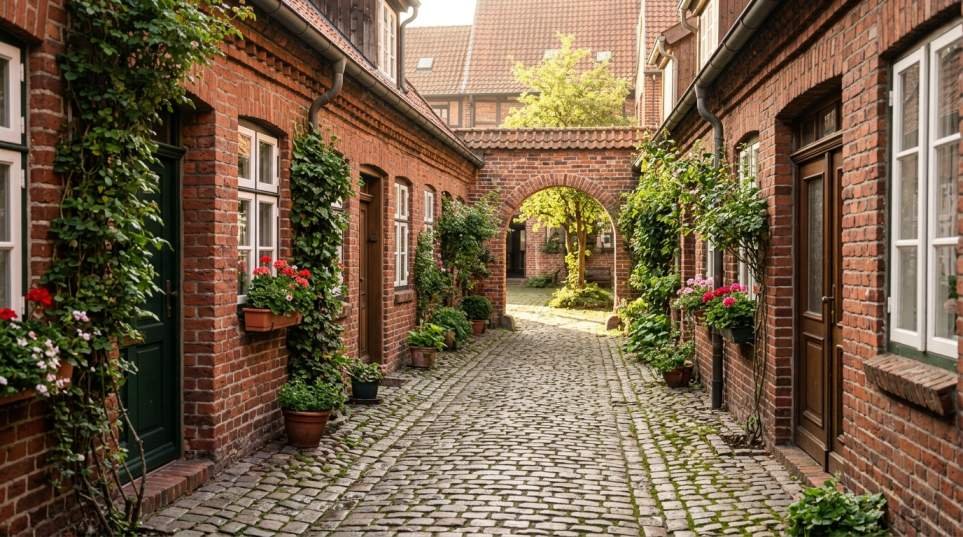
Behind the red-brick facades of Lübeck’s old town lies a second, quieter city. Narrow passages, tiny cottages, and leafy courtyards are tucked away behind the main streets, and most visitors walk right past them. These hidden spaces are among the most atmospheric places in the city, and they are part of the UNESCO World Heritage Site that covers the old town.
This guide covers the best courtyards and alleys to look for, how to group them into easy walking routes, and how to visit respectfully, since people still live in them.
Why Lübeck Has So Many Hidden Alleys
The first alleys and small dwellings appeared in the early 14th century, when trade was booming and the population grew faster than the space available. Builders filled the deep plots behind the street-front merchant houses with small homes for workers and craftspeople, reached through narrow passages.
Later, wealthy merchants and councillors added a second type: charitable courtyards. These were built as housing for widows and the elderly, and many are far more elegant than the working-class alleys. Today almost all of the alleys and courtyards are open to the public, although they remain private homes.
10 Best Courtyards and Alleys to Visit in Lübeck
1. Füchtingshof
Füchtingshof is the grandest of Lübeck’s charitable courtyards. It was founded in 1639 by the councillor Johann Füchting and sits at Glockengießerstraße 23–27, entered through a baroque portal. Inside, you will see symmetrical rows of small houses with paired doorways and an arcaded house closing the far end.
The residents ask visitors to enter only during set daytime hours, listed as 9 a.m. to 12 p.m. and 3 p.m. to 6 p.m. Check the sign at the gate, because the rules can change.
2. Glandorps Gang and Glandorps Hof
A few steps from Füchtingshof, on the same street, are two more beautiful sites. Glandorps Gang and Glandorps Hof lie along Glockengießerstraße, roughly between numbers 39 and 53. The buildings were restored in the early 1980s, while keeping their original purpose as housing for older residents, and the court is open to the public.
Visiting Füchtingshof and Glandorps together makes a perfect first stop, since the two are within sight of each other.
3. Dunkelgrüner Gang
This is one of the most photographed alleys in the city. It runs between Engelswisch 20 and 28. It is one of the newer charitable courtyards, founded between 1727 and 1729, and takes its name from the widow of the wine merchant Johann Haase, who established it.
The low entrance and the green, quiet courtyard behind it make it feel like stepping into another century.
4. Hellgrüner Gang
The Hellgrüner Gang is a neighbor to the Dunkelgrüner Gang, with an entrance on Untertrave. It makes sense to visit both on the same walk, since they are close together and show how different two alleys can look in the same neighborhood.
5. Von-Höveln-Gang
This alley is on Wahmstraße, around numbers 73 to 77. Work on it began in 1481, when the councillor Tidemann Evinghusen created housing for 45 poor women. It is a good example of how charity shaped the city’s hidden architecture.
6. Haasenhof
Haasenhof is on Dr.-Julius-Leber-Straße, at numbers 37 to 39. It is a calm courtyard away from the busiest streets, which makes it a pleasant place to rest during a longer walk.
7. Kalandsgang
Kalandsgang is on Hartengrube, at number 52. Hartengrube has several passages along it, so this is a good street to slow down on and look at every doorway and archway.
8. Von-Dornes-Hof
Von-Dornes-Hof is on Schlumacherstraße, at numbers 15 to 23. It is a lesser-known stop, so you may well have it to yourself.
9. Blohms Gang
Blohms Gang is on An der Obertrave, at number 50. Its location near the water makes it easy to include on a stroll along the Trave river.
10. Schwans Hof
Schwans Hof is on Hartengrube, at number 20. Together with Kalandsgang, it makes Hartengrube one of the best streets for finding hidden passages in a short distance.
Three Easy Walking Routes
You do not need a strict plan, but grouping the sites by area saves time.
Route 1: Glockengießerstraße (about 45 minutes). Visit Füchtingshof and the Glandorps courtyards first, then continue toward Haasenhof. This is the best choice if you have limited time.
Route 2: Hartengrube and Wahmstraße (about 1 hour). Walk Hartengrube for Kalandsgang and Schwans Hof, then continue to Von-Höveln-Gang on Wahmstraße.
Route 3: Along the Trave (about 1 hour). Combine Blohms Gang on An der Obertrave with the Dunkelgrüner and Hellgrüner Gänge near Engelswisch and Untertrave, and finish with a walk along the water.
How to Visit Respectfully
People live in these courtyards, so a few simple habits make a big difference.
Keep your voice low, stay on the main path, and do not look into windows or open doors. If a gate is closed, do not go in. Take photos of the buildings and plants, but avoid taking pictures of residents without asking. Drones are out of place here. Visiting during the daytime is best, since some gates close in the evening.
Practical Tips
Wear comfortable shoes, because most passages have cobblestones. Some entrances are narrow, and several have steps or uneven ground, so they can be difficult for wheelchairs and strollers. Early morning gives you the best light and the fewest visitors.
If you want more history and access to places you might not find alone, consider joining a guided old-town walk.
Final Thoughts
Lübeck’s courtyards and alleys show a side of the city that grand churches and museums cannot. They are small, lived-in, and full of history. Give yourself an hour or two, go through the archways that look slightly too narrow, and you will find the part of Lübeck that most visitors miss.
Frequently Asked Questions
Are the courtyards and alleys in Lübeck free to visit?
Yes. Almost all of them are open to the public, and there is no entry fee. Some have posted visiting hours, so check the signs.
How many courtyards and alleys are there in Lübeck?
Around 90 or more survive in the old town, depending on how they are counted, down from many more in the past. You do not need to see them all, since the best ones are concentrated in a few streets.
What is the most beautiful courtyard in Lübeck?
Many people consider Füchtingshof the most impressive, thanks to its baroque portal and well-kept houses. The Dunkelgrüner Gang is a popular favorite for its atmosphere.
Can I take photos in the alleys?
Yes, photos of the buildings and surroundings are generally fine. Be discreet, avoid photographing residents, and do not use drones.
Are the alleys wheelchair accessible?
Many are difficult because of cobblestones, steps, and narrow entrances. Check ahead with the local tourist information office for accessible routes and sights.
How long does it take to see the main courtyards?
A short visit to the Glockengießerstraße courtyards takes under an hour. For a fuller tour of several areas, plan on two to three hours.
Is there a map of the courtyards and alleys?
Yes. You can use the addresses above in Google Maps to build your own route, or ask the Lübeck tourist office for a printed map of the old town.
I can also write a featured image prompt for this article, with a courtyard scene in the same prompt style as the birthday articles.